
Having had the opportunity to research on the mechanism that olfactory receptors use to detect an odourant makes me very proud to have contributed, even slightly, in the process of deciphering olfaction, the last of the senses which hasn't been fully decoded yet…
Research in the field of olfaction has historically been sparser than in the optics or acoustics field due mainly to biological reasons that make the sense of smell difficult to grasp, but also historical biases. Ever since COVID hit, the situation changed and a universal understanding of the importance of smell (and its loss) in our lives arised. Unfortunately, in 2012, when I started my PhD research on olfaction, the financial support and international scientific interest was still very low. The three main reasons for that were:
1. Evolutionary and historic reasons diminish the importance of smell in humans.
2. Obstacles in the researching due to the absence of universal vocabulary for the description of odors and also subjective and varying criteria that affect the judgment of the smeller such as preference, hunger, memory or even the odor’s concentration or purity.
3. Particular complexity in the understanding of the biological system (e.g. olfactory receptors have been isolated but never in a crystalised form and thus their complete conformation remains unknown).
Luckily, in 1991 the discovery of the genes expressing olfactory receptors by Buck and Axel is awarded a Nobel prize and the scientific community suddenly obtains tangible results on which it can rely and base further studies and discoveries. Until then, the data was vague and based on philosophical speculations. The prevailing hypothesis for the mechanism of odorant recognition was the “theory of shape” and remains the most popular until today. It states that an odorant molecule approaching an olfactory receptor will only bind to it if its shape and the receptor’s shape match exactly, just like the key with the lock. This should imply that molecules having similar structures bind to the same receptors and thus are characterized by the same odor. But this is not the case with all molecules, and the exceptions to this rule are many. For example, the molecule of ethanol (see pic) smells of alcohol and ethanethiol smells of rotten eggs while both molecules share similar structures (ethanethiol contains a sulfur atom instead of an oxygen atom).
In 1996, an earlier olfactory theory reemerges. It refers to the vibrations of the odorant and not its structure being responsible for the receptor activation. Luca Turin, who supervised my PhD Thesis from 2012-2017, based on the newly discovered data about the olfactory system, reiterates preexisting studies (already from the 1930s), introducing a quantum mechanism of the odorant detection, which resembles that of spectroscopy. This mechanism is the inelastic electron tunneling. That is to say, each receptor is triggered by a molecular vibration of energy E, which once coupled to an odorant of the same energy, will activate the process of transferring the smell signal to the brain. In this case, molecules that have an energy spectrum (i.e., a way of visualizing this is the infrared radiation absorption spectrum) will also exhibit a similar smell. Thus, it can be explained why ethanethiol and ethanol have such different odors: ethanethiol, containing a SH bond has a very different spectrum in the infrared region than ethanol.
My experimental research was eaxctly on the “vibrational theory” and my results showed clear evidence that vibrations are involved in the odourant recognition by an olfactory receptor.
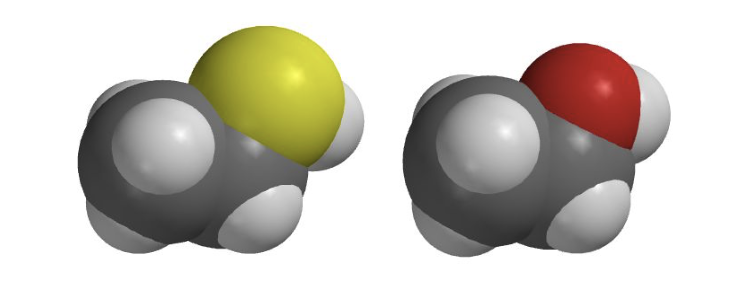
Ethanethiol vs Ethanol